
In the 1800s, homesteaders began building in the Blue Ridge Mountains in what is now Shenandoah National Park. But the transition from farmland to park land has a dark history of destruction and displacement.
Homesteaders built mills and stores, planted orchards and crops. They logged and mined the mountains. The Long family acquired a large tract of land comprising most of the Naked Creek watershed. They cleared the land for pastures and grazed several hundred head of beef cattle in the hollow, driving them down the mountain to market each fall.
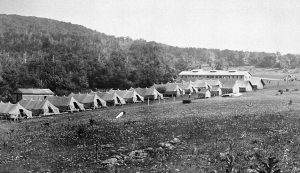
Skyland with CCC camps, 1933.
In 1886, Entrepreneur George Freeman Pollock inspects a tract of more than five thousand acres of mining land, owned by his father, around Stony Man. Resort owners join the campaign for a National Park on the Blue Ridge. Pollock becomes a driving force in the park effort.
Pollock establishes the Stoneyman Park Preserve, a rustic vacation resort, after his father’s mines fail. He later renames it Skyland. During the depths of the Great Depression, the first Civilian Conservation Corps (CCC) camps were established at Skyland.
Tourism entrepreneurs join Pollock and convince the Commonwealth of Virginia to begin buying 176,429 acres on over 3,000 individual tracts in the Blue Ridge Mountains while they campaign for the establishment of a Blue Ridge National Park. Nearly 40 percent of the future park land is owned by only fourteen families and companies, including the Long and Graves families. The Long family agrees to sell the Commonwealth a large tract of land on the east side of the Blue Ridge, provided the Naked Creek tract will remain privately held.
President Calvin Coolidge signs a bill authorizing the establishment of Shenandoah National Park but authorizes no funding to obtain the land. The State continues to buy land for the park.
Park supporters are near their goal of acquiring a contiguous tract of land but are frustrated by landowners who won’t sell and squatters who refuse to move. Virginia Governor Harry Byrd and Virginia State Commission on Conservation and Development chairman William Carson persuade the state legislature to pass the Public Park Condemnation Act, granting eminent domain to purchase all land at fair market agricultural value. The price paid ranged from $1 to $131 per acre.
In 1929, Carson convinces President Herbert Hoover to purchase 164 acres on the Rapidan River within the slated park boundary, at $5 per acre, for the site of his “Summer White House.”
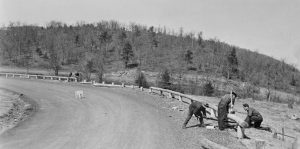
Lining Skyline Drive with wooden log guardrails
In 1930, Virginia saw its worst drought in history. This gives Carson and President Hoover an opportunity to hire displaced out-of-work farm laborers to build a paved road to Camp Rapidan. Hoover backs a bill allowing Federal drought-relief funds to be used to pay the wages. This will become the first segment of Skyline Drive, linking Panorama to Skyland and ensuring the eventual establishment of the park.
Virginia wins a Supreme Court suit challenging the constitutionality of its blanket condemnation law. It then takes title to the remaining confiscated land and begins forcing land sales.
To ensure that the eviction process is not abandoned, Pollock gets unscientific “studies” published in newspapers, painting the local communities as isolated and primitive and builds public support for displacing the local inhabitants by characterizing the relocation as humanitarian assistance.
NPS Director Arno Cammerer announces that the Federal government will not accept land for the park from the State until all the residents have departed the area, but allows forty-three families to remain on their land, rent free, after selling their property to the state.
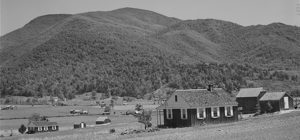
Displaced residents on 2–5-acre tracts of land on Ida Valley Farms and Shenandoah Homesteads.
For the remaining residents and tenants, the Interior Department establishes the first of six homestead sites for resettlement of 500 displaced families on 343 acres just east of Stanley, at Ida Valley Farms and Shenandoah Homesteads.
The program will also provide low-interest loans to purchase 2-to-5-acre tracts in these Government-created communities, referred to as Farm Security Administration (FSA) projects or camps which are now popping up all over America.
The FSA was an agency created in 1937 to combat rural poverty during the Great Depression in America. Poverty-stricken residents were either relocated to allow Government projects to be constructed where they previously lived or relocated to agricultural areas to support farming efforts.
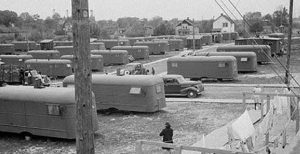
Poor neighborhood displaced to this trailer camp to build the Pentagon
The Pentagon, originally known as “Arlington Farms,” began construction on September 11, 1941 (exactly 60 years prior to the 9/11 attacks) The site was once a poor neighborhood that was displaced to an FSA trailer camp.
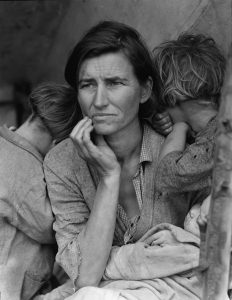
“Migrant Mother.” Florence Thompson, a destitute pea farm picker in California is pictured with three of her seven children. Photo taken in 1936 by Dorothea Lang, FSA photographer.
Today, there is little evidence of these FSA camps except for some very recognizable images.
The FSA is famous for its iconic and highly celebrated photography program, 1935–44, that portrayed the challenges of rural poverty. The photographs in the FSA/Office of War Information Photograph Collection form an extensive pictorial record of American life between 1935 and 1944.
By 1937, the first of 172 families are moved into homesteads with assistance from the CCC. The small size of the homestead sites forces the resettled farmers to work in local agricultural or industrial enterprises. Those who are not eligible for loans become tenants of State welfare agencies. In most cases, the rental fees they pay (annually) for a smaller parcel of land is more than what they were paid for the larger parcels they previously owned. The remaining families are resettled within a year.
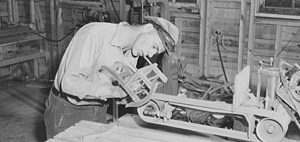
Displaced resident woodworking in the Arts and Crafts shop established by the FSA Project, Ida Valley Farms.
Residents who refuse to leave the park are forced out by the authorities. Their homes are quickly demolished as part of the effort to speed the land’s return to a natural state, and to ensure that residents do not return. Tenants make up more than half the population, and they receive no compensation.
In one case, sheriffs forcibly evict tenant Walker Jenkins and his family from their Big Meadows home, tearing down the house in the process.
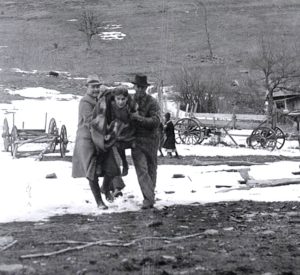
Lessie Jenkins being forcibly evicted – 1935.
Once they are evicted, Secretary of the Interior Harold Ickes accepts title to the land from the Commonwealth of Virginia. The CCC begins to build visitor facilities, roads, and trails… and plant trees?
In a very telling letter to the NPS director, Arno Cammerer, a member of the Southern Appalachian National Park Committee, Harlan Kelsey, makes recommendations for the park’s forests.
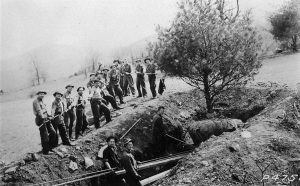
Members of the Civilian Conservation Corps transplanting a tree in Shenandoah National Park.
Although advocating the restoration of vegetative communities “as they originally existed”, Kelsey also supported the desire to create a less “monotonous” landscape with more aesthetic “values.” So, they planted thousands of native and non-native trees and shrubs along Skyline Drive.
The design would allow park visitors to stay in their cars and observe the beauty along Skyline Drive, stopping at the paved overlooks along the way, but for goodness’ sake, not to physically hike!
He recommended thousands of Hemlocks and White Pine to be planted to create a more unique landscape. He also said there were Mountain Laurels and other Azaleas that were being choked out by weedy deciduous trees and shrubs …judicious cutting should be done to develop these areas into fairly pure stands of the variety which deserved dominance.
He recommended Bittersweet and wild Grapevines to cover embankments and steep slopes at overlooks as they are extremely pleasing and naturalistic. (We now know those are invasive vines that plague the park today.)
In 1938, President Franklin D. Roosevelt dedicates Shenandoah National Park. Despite its rocky beginning, Shenandoah National Park’s beauty and wildlife are enjoyed by millions of visitors each year.
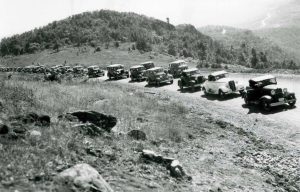
Skyline Drive opens, 1935.
Sources: Wikipedia, https://www.nps.gov/articles/wilderness-by-design.htm and Old Time Stanley and Page County FB page.